Friday, July 17, 2015

In the garden thinking these chicken brats aren’t cheap


I come to the garden alone while the dew is still on the roses… I love that song. These tiny roses are on our front porch.


My garden doesn’t look picturesque but here’s my first harvest.  4 ripe grape tomatoes I used in my omelet this morning.

I also noticed the squash is growing so fast and it’s overtaking my garden.  I should probably have planted only two.  I didn’t realize they grow like weeds and I’ve planted about 5 of them. 


 This one is spaghetti squash. 
 I’m not sure if this is ready to harvest.  I don’t have experience with squash or starting a garden from scratch.  This is my very first.  I’m happy I did it.  The two dill plants are collapsing to one side.  I suspect my chickens must have gotten into my garden and scratched it.  One thing I noticed is that they don’t like basil.  That’s good because I love basil.  They love tomatoes though.
I fed the chickens some cantaloupe yesterday and they loved it (video below).


I admit keeping small flock of chicken does not make any profit. They pay for their feeds only in the spring/summer because they free-range.  But they will be forever paying for their ‘mansion’.  It costs more than you think. Absolutely no profits. I lose money to housing, wood shavings for their bedding, medicine, oyster shells, and some random deaths.  They cost me more than they are worth.  But having a fresh source of eggs is priceless.  Sure it’s cheaper at the groceries, but I know exactly what goes into my eggs.  There’s no comparison.  I figure it will take about 15 to 20 years to break even with what I’ve spent on the coop and my labour.  So I should just look at it as if they are my pets that produce eggs.  No profit to be made other than the enjoyment every chicken gives me!

It’s very relaxing to see chickens on my pasture.  It gets me into this meditative state only me can probably understand.  They are cheap entertainment too.  Each one has personalities.
I’m forcing myself not to get too attached to them because any roosters will have to go to the butcher before fall.  Everyone on the homestead should have a purpose.  Males mean trouble!

Tuesday, July 14, 2015

Trying to save my 4-week old chicks...


What a challenging week it's been so far and this happens on the week I'm off from my day job when I initially intended to just relax.  So let me rant…

Last Friday, 5 of my 4-week old chicks died.  By Saturday morning 2 more died.  And by Tuesday morning, 2 more died.  A total of 9 chicks died out of the 25.  That’s a major casualty.  When only 3 died last Friday, I was going to let natural selection to happen.  But 9 out of 25 is a big loss.  Based on the symptoms, the vet told me that they have coccidiosis (a common disease and most chicks are born with it).  All these chicks are living separately from the adult chickens and they do not share the same pen or run to avoid infecting the healthy adult chickens.  The rest of the adult chickens are all healthy.  

Anyway, the vet prescribed Amprolium but the problem is that her clinic does not stock it because they deal mainly with dogs and cats.  She referred me to the local farm supplies and another vet who deals with cows.  I did and our local farm supply does not carry it.  The local vet that deals with the cow won’t sell it to me obviously because they said they can only prescribe it to cows and not chicken.  I was determined to find a place that sells this because I don’t want to loose all 25 chicks.  About 4 of the ones that are still alive are showing the symptoms (lethargy, blood in poop and depression). The vet said I can maybe save them from dying if I give them the medication as soon as possible. So I called various different vets who are even over an hour away from us and no luck.  I probably phoned more than a dozen places.  I tried the Peterborough veterinary but unfortunately, they cannot sell it to me either because they need to physically see the chicks.  They can get in trouble if they don’t and I totally understand.  But there’s no point for me to bring the chicks. Their reception was very helpful enough and recommended I check the local farm co-op in Peterborough.  And I was so relieved that they carry it.  I called my dad to give me a ride to Peterborough and I was shocked to find out the price.  $130 + tax for 3.8 L medication.  They don’t sell it in smaller amounts.  I only need a very small amount because it is something you mix in the water.  The proportion is 500 ml medication mixed to about 200 L of water.  Yes, I really need just a very small amount.


One thing I don’t understand is if I buy this from the vet, they require prescription but anyone can buy this extremely pricey medication from the farm store.

So the cost of treating a chicken can be in the hundreds of dollars but the chicken alone is not even worth more than $15 each.  It’s insane. But I purchased it anyway.  Vet confirmed this medication is safe for chicks that will lay eggs later. This is becoming a really expensive hobby.  

So how does other poultry or beef producers do it with totally NO medications?  I see them in grocery stores labeled antibiotic-free or no medications, etc.  I mean how is it even possible?  I did not feed my chicks any medicated starter feeds even though it is recommended because I wanted them to be as natural as possible.  But when something kills your livestock, then it is a great loss.  I now totally understand why antibiotics are used in cattle (that costs thousands of $ each) for example.  To be totally antibiotic free, in my personal view means you will have to clean their housing 24/7 to prevent disease.  How is that possible?  If one gets infected, it will spread to the rest of the flock.

I’ve hatched 3 batches of chicks this year and the last batch (25 chicks) had coccidiosis. I didn’t have the ducklings in the first two batches. The vet said it could be because I raised 2 ducklings along with the chicks.  I knew about the risk of mixing them but I thought well, it’s only 2 ducklings anyway so maybe it will be fine.  Well, I will never do it again.  Ducklings are a lot messier.  They poop on the water.  And that’s what infected the chicks.  They were indoors up until they were 3 weeks old.  They were living outside in their coop for just over a week when the chicks started dying.  While they were indoors, I replaced their water almost every 3 hours during the day.  But once they are outside I cannot do that anymore.  I only replaced their water once or twice a day if it’s dirty.  And that’s probably what caused it.

I almost screwed up with the proportion of the medication to water though.  Below picture shows the mixing directions.  I missed  the part that says “then add water to the 200 L mark”.  So my first mixture was 8 times STRONGER and I’ve already given some.  Only a few drink it maybe because it is too saturated and I could smell it being too strong.  The mixture was in their coop for about half an hour and after I was done doing the other chores, I started to think and said to myself “wait a minute, what was that 200 L supposed to mean then?”  I’m glad I double checked and corrected it immediately.  I pray that whoever drink the first really strong mixture will survive.

Lesson learned, do not mix ducklings with baby chickens!

Monday, June 22, 2015

Puff & Squeek - First time outside

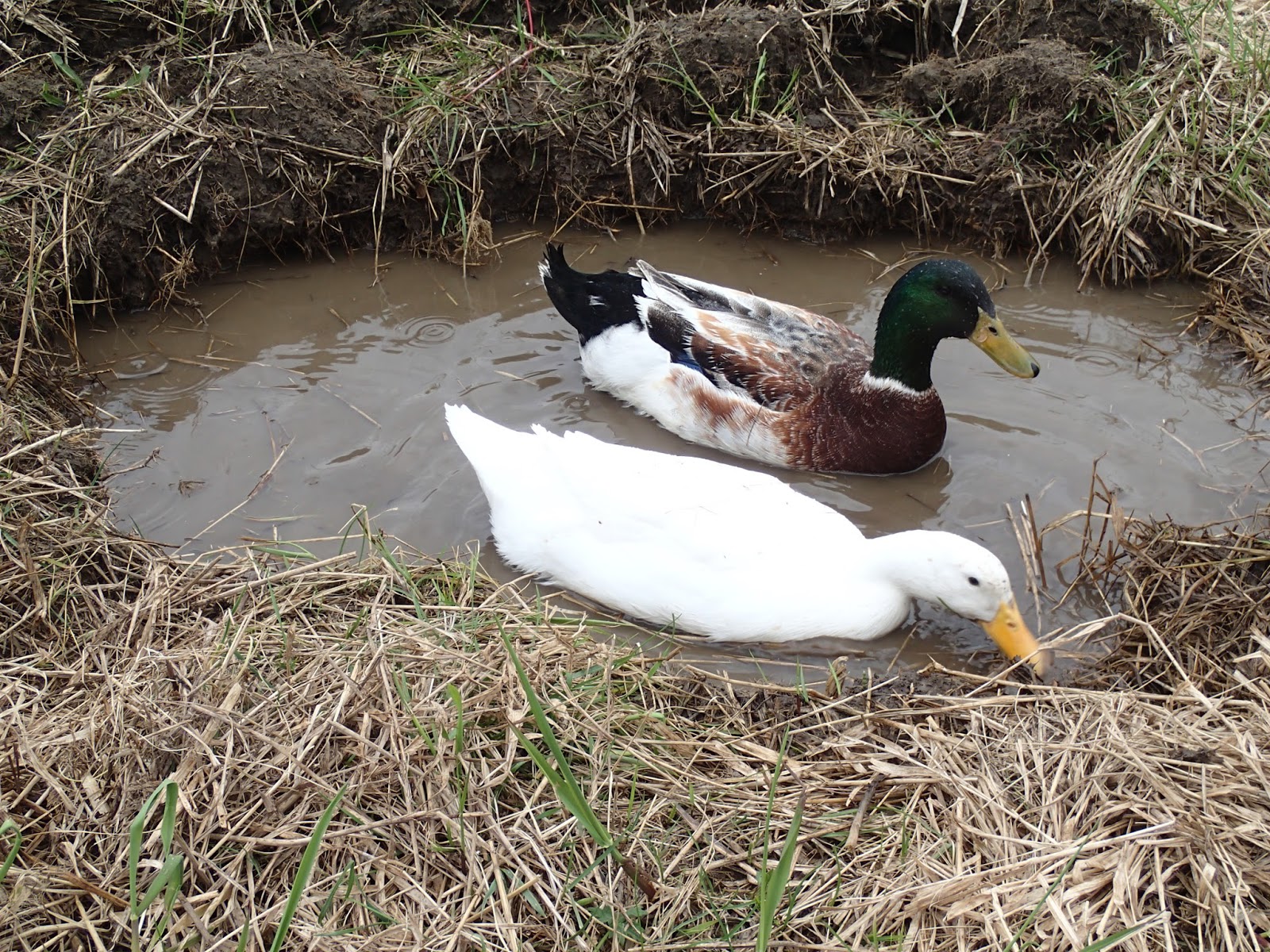
I brought my 2 ducklings Puff and Squeek outside for the first time.  They are just over a week old.  They spent just a few minutes outside.  I let them swim in the tub.  They followed me everywhere.  So cute!


Introducing Puff and Squeek to their parents but they don't have a clue.  The parents Mr. & Mrs. Ducky don't recognize them at all and seem to be scared of the ducklings. Video below.

Here's their video swimming outside for the first time.


Thursday, June 18, 2015

Puff & Squeek – Super Cute Fluffy Yellow Balls


Being my day off today means I’ve got time for blogging.  First I thank God that another duckling hatched last weekend after the 2nd healthy-looking one died within 24 hours of hatching.  Now I have 2 ducklings again.  It’s always good to have them as pairs.  I only had 8 duck eggs set in the incubator, 2 were infertile, 2 full-term failed to pip, 1 pipped but failed to hatch, and 1 died within 24 hours of hatching.

I got interested with ducklings when my massage therapist suggested the natural progression before I get a couple of goats or sheep is to try ducks first.  And ducklings are very cute.  Much cuter than baby chicks.  Since I only have two ducklings, I gotta have names for these fluffy yellow balls.  I don’t know their genders yet but the bigger one (first born) I suspect is a male (drake) and it is very bossy.  The smaller one is more reserved and possibly a female (hen).  I’m just guessing at this point.

I’m naming the bigger one Puff (the feisty first born) and the smaller one Squeek.  I helped Squeek crack the egg and it’s a miracle he/she survived.  Today, Squeek is 4 days old and Puff is 5 days old. 

Here’s the picture of Puff (the bossy one).  Look how big it is compared to the 5-day old baby chick.


And below is Squeek.  Trust me, it's not a toy.  It's a real duckling!  Ducks have permanent smile on their face.

And here's the video I took of Puff.


Since they live with 25 baby chicks, they probably think they are chickens, haha.  By the way the first picture below suggests, the heat lamp was too close to them that's why they are sleeping in circular position.  I pulled the heat lamp higher so they feel a lot cooler.


And I’ve introduced Squeek to Sweaty cat.  They seemed to get along.  


And below is the video of Sweaty Cat being introduced to Squeek (or the other way around).
 
Our cats don’t harm any chicks at all.  I’ve left the brooder open and had already 3 batches of hatchings.  One time I discovered the cat sleeping with them though and eating their food.  Not a good idea.  But he never harmed the baby chicks.

Their parents are Mr. & Mrs. Ducky.  This was taken this spring.  They made the eggs and I hatched them in my incubator.

On the other hand, Mrs. Ducky has not laid an egg for 3 straight days.  I’m wondering if she’s laying it somewhere else as I let them free-range all day.  It’s unusual because she should lay on a daily basis and her diet hasn’t changed at all.  Well, except now she’s eating more bugs.

Monday, June 08, 2015

Farewell Roosters


Roosters’ last day!

Today is the day I’ve been waiting for since the roosters had been messing with the hens and at one point killed a hen.  They are going to the local butcher shop.  It will cost me $3.35 per chicken to have them slaughtered and dressed.  It will be additional cents if I wanted them weighed but I don't need that as we will just eat them ourselves anyway or give away to family or friends.  

I have 13 roosters and I want to keep only one as a guard rooster.  However I’m torn apart which one I should keep.  I have to capture them tonight and put in boxes in preparation for delivery very early tomorrow morning (7 am).  I’d love to keep more than one as pets but the feed cost gets too expensive.  I have 44 laying hens at the moment and 21 growing chicks.  Based on statistics, it usually is 50/50 chance of hens and roosters so I might end up with 10 or 11 cockerels out of these 21 chicks.  Plus I have 38 eggs in the incubator expected to hatch this weekend and I plan to sell them and whatever doesn’t sell I will keep.

Anyway, the purpose of this blog is to decide which of these short-listed 3 roosters I should keep.  I’ve been thinking of keeping this one (pic below) because he is very light and it won’t be too much weight to bear for the hens when he breed them.  And I love the multi-colour as it looks unique.  This is a Dorking cross.  Easy to catch when needed and quite gentle.  However this is not a very good guard rooster in case there’s a hawk attack.  He’d be the first one to run away instead of defending the hens.

My second choice to keep is this one below.  He is also very beautiful.  From the very young age, he has been always tame and even let me put a ribbon costume on him last fall.  However, he’s a bit on the heavy side and it can injure a hen when he’s breeding.  But like the one above, he’s very efficient when breeding.  What I mean by that is unlike other roosters, he quickly dismounts the hen and pretty quick in breeding.  The others sometimes would remain standing on top of the hen even when they are finished doing it and causing the hen's back to bleed.

And my third choice is the rooster below.  He is a large Brahma mix breed.  I like the colour as it matches my other Columbian Rock hens.  He is also very friendly and very easy to catch if needed.  However he’s very heavy and not very efficient in breeding hens like the second one above.  His heavy weight can also injure the hens while breeding.  I like the feathers on his feet though.